
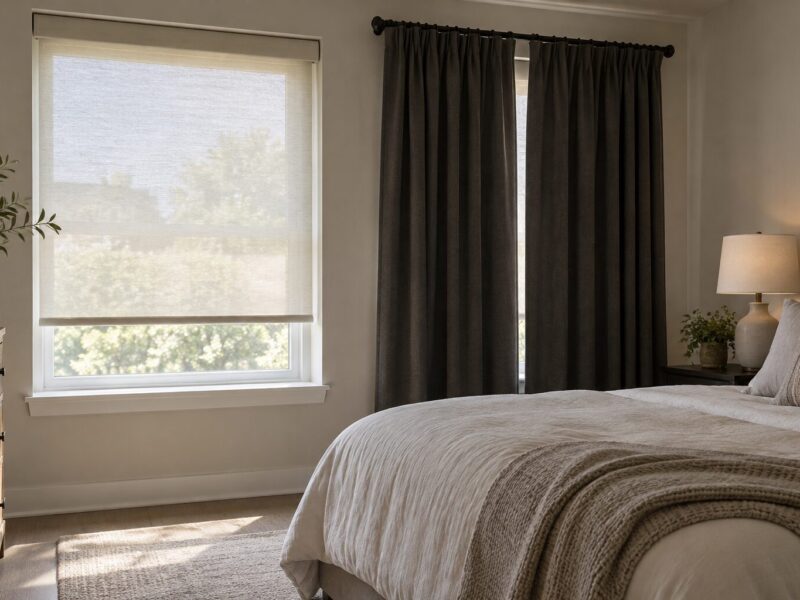
Choosing between blackout and light-filtering curtains starts with the room’s job. Bedrooms, media rooms and shift-work spaces may need stronger light control; living rooms and kitchens often benefit from daylight that stays soft and comfortable. In Kansas City, the right custom window treatment also depends on window direction, privacy, neighboring homes and how the room is used through the day.
“Blackout” and “light-filtering” describe different levels of light control, not two interchangeable looks. Blackout fabric blocks most light through the material, while light-filtering cloth diffuses daylight. Neither label alone guarantees a completely dark room: light can still enter around the sides, top or bottom of a window. A layered design can combine practical shades with decorative drapery for a more flexible result.
Blackout and Light-Filtering Curtains in Kansas City: What’s the Difference?
Blackout curtains use an opaque construction or lining to limit incoming light. They are a common choice for bedrooms, nurseries, guest rooms and media spaces where a darker setting is useful. The amount of room darkening depends on the fabric, lining, overlap and how closely the treatment fits the opening. If darkness is the priority, ask about the entire installation, including side returns, the top treatment and the gap near the sill, not just the fabric label.
Light-filtering curtains let daylight pass through the fabric in a softened form. They can reduce harsh brightness and provide daytime privacy, depending on the weave and lighting conditions. At night, an illuminated room may be visible from outside through many light-filtering fabrics, so they should not be treated as a substitute for complete privacy. A shade underneath can add control when a room’s needs change from morning to evening.
Sheer, light-filtering and room-darkening are not exact synonyms. Sheers are usually more transparent; light-filtering fabrics soften rather than eliminate daylight; room-darkening options reduce more brightness without always being true blackout. Product descriptions vary, so comparing actual fabric samples in the room is more useful than relying on names alone.
Choose Custom Window Treatments by Room and Light Control
Bedrooms and Nurseries
For bedrooms, consider sleep schedules, streetlights, sunrise and privacy. Blackout-lined drapery or a blackout shade can help make the room darker, while a separate sheer or light-filtering layer preserves daylight when desired. A cordless or motorized operating style can make daily adjustments easier. For homes with young children, review current CPSC guidance on window-covering cord safety and choose products accordingly.
Living Rooms and Kitchens
Living spaces usually need a balance: comfortable daytime light, a view when wanted and privacy after dark. Light-filtering curtains, roller shades or cellular shades may soften glare without making the room feel closed in. For wide exposures or a television area, test samples at the time of day when glare is strongest. If privacy varies by hour, combine a shade with side panels so each layer has a distinct purpose.
Home Offices and Media Rooms
Computer screens and televisions reveal whether a fabric filters enough light. Try a fabric sample near the screen and at the window, because a treatment that looks translucent in a showroom may appear different against bright outdoor light. Blackout panels may suit a dedicated media room, while a light-filtering shade can work better in a shared office that still needs natural light.
Compare Curtains, Blinds and Shades for Kansas City Homes
Curtains are only one type of window covering. A roller or cellular shade provides a clean, close fit at the glass; blinds have adjustable slats that can redirect light; shutters offer a more built-in appearance with louvers for light and view control. Custom blinds in Kansas City can be paired with drapery when a homeowner wants both precise adjustment and a softer finish. The right choice depends on how much light, privacy and upkeep each window needs.
For a layered room, a shade can handle everyday privacy and glare while drapery adds texture, color and another light-control layer. When open, panels frame the window. When closed, their overlap can help limit side light. Layering gives a homeowner more choices than asking one fabric to do everything. Browse custom blinds, plantation shutters and roller shades to compare options.
Fabric, Fit and Installation Affect the Result
Window dimensions and hardware matter. Curtains that are too narrow may leave gaps; a rod mounted close to the frame can limit how far panels stack away from the glass. Lining can add body and improve light blocking, but it changes the drape and weight. Ask how the selected fabric behaves when open and closed, whether it needs a special track, and how it should be cleaned. A custom solution should suit the window and the interior, not just a catalog photo.
Professional measuring can account for trim, nearby walls, furniture, door swings and the preferred look. It is especially useful around a sliding glass door or hard-to-reach windows, where the screen, handle or walking path affects how the treatment operates. Inside Solutions offers choices in drapery and blackout and light-filtering curtains, as well as window treatments that can be motorized. Ask about the product and controls before assuming they fit a particular window.
Energy Efficiency and Seasonal Comfort
Window coverings can affect comfort by changing how much sun reaches a room and by adding a layer at the glass. Their performance depends on the window, orientation, fabric and how consistently they are used. The U.S. Department of Energy explains that window treatments can help manage heat gain, heat loss and daylight; see its overview of window treatments and energy efficiency. Treat this as one part of a home-comfort plan rather than a promise of a specific utility-bill reduction.
During bright afternoons, closing a shade or lined curtain before direct sun heats a room may improve comfort. In cooler periods, opening treatments to use available sunlight and closing them later can be a practical routine. Different windows, even in the same room, may need different choices. A free in-home consultation lets a homeowner compare fabric samples in context and request a quote for the selected installation.
How to Select the Right Window Treatment
Start with each room’s main need, then compare samples at the window. These questions can help narrow the options:
- Write down each room’s main need: sleep, privacy, glare reduction, view or decorative finish.
- Notice when direct sun reaches the glass and whether neighboring sightlines matter in Kansas or Missouri.
- Compare samples at the window in daylight and after dark; check opacity and color against the actual walls.
- Decide whether a single treatment is enough or whether a shade-and-drapery combination is more useful.
- Confirm measurements, mounting height, hardware, operation and maintenance before ordering.
Homeowners in Olathe, Overland Park, Lenexa, Leawood and nearby Johnson County communities can compare fabrics and operating styles with a designer before deciding. A consultation helps connect the room’s light and privacy needs with realistic product choices. For curtains and blinds in Kansas City, schedule an in-home consultation to review blackout, light-filtering and layered window treatments.
Window Shades, Custom Blinds and a Local Quote in Kansas City
A custom window treatment can be adjusted to each opening rather than chosen as a standard size. Blinds in Kansas City, Kansas may suit a room where slat adjustment matters, while a shade can simplify a wide expanse of glass. Homeowners comparing options can bring measurements, photographs and questions about installation to a free consultation. The goal is to select a fabric and operating style that works in the home, then confirm a practical quote before ordering.
Drapery and Custom Blinds in Kansas City, MO
When a homeowner compares drapery, shades and blinds, a consultant can bring fabric samples and explain how each option will operate on the specific window. Inside Solutions serves nearby Kansas communities, including Olathe and Overland Park; ask for a written quote with product, installation and control details.
Frequently Asked Questions About Blackout Curtains
Are Blackout Curtains Completely Dark?
Not always. Blackout material blocks most light through the fabric, but light may enter around the edges or above and below the treatment. Fit, mounting and overlap affect the result.
Do Light-Filtering Curtains Provide Privacy at Night?
They can provide daytime privacy in some settings, but an illuminated room may be visible from outside after dark. Add a shade or another privacy layer if nighttime privacy matters.
Can Blackout and Light-Filtering Curtains Be Used Together?
Yes. Pairing a shade or lighter curtain with lined drapery allows flexible daylight and privacy control. Select compatible hardware and allow enough space for both layers to operate.
 Natural Woven Shades in Kansas City, MO: Light, Privacy & Style
